
Getting Wabasha County Court Records
There are three ways to get Wabasha County court records. Each serves a different need. For free remote access, MCRO lets anyone run a case search and pull up some public documents from home. The courthouse goes further. Its public-access terminal and counter support inspection that is broader than what remote docket search offers, and Court Administration handles certified copies, file availability, and questions about a specific case number. Call (651) 412-8627 to reach that office.
Mail works when a trip to Wabasha County is not practical. Write out the case number and the document or record you want. Add the event date if you know it, the copy type, your phone or email, your mailing address, and any payment due. Attorneys and parties can also submit a copy request directly into a case through Minnesota eFile and eServe. That platform handles filing and service, though, not public browsing of court records. The court offers no fax submission. Phone first if fax is your only tool.
- Confirm the case number in MCRO or provide enough party, case, and date information for Court Administration to locate the matter.
- Check MCRO Document Search for a free public download.
- Contact Court Administration before sending payment for a certified, older, or special copy.
- Use the counter or terminal for authorized in-person inspection.
- Mail a precise request, or use eFile and eServe if the court directs a party to file it.
Wabasha Copy Request Details
Viewing a docket entry on MCRO is informational only. The court's own records service is a separate thing. Wabasha County counter copies are usually same day, unless the file sits in offsite storage. Ask three things when you arrive. Does the file need retrieving? Does your purpose require a specific certification, and does any restricted-data rule apply? When a public filing does not show up in remote docket search, the courthouse terminal is the fallback.
Statewide rules govern mail requests. Use a Wabasha County form if one is available; otherwise a statewide form or a plain letter will do. No county-specific form exists with public field-level instructions, so a clear written request matters most. Say exactly what you need: the Register of Actions, an order, a judgment, a pleading, an exhibit, a transcript, or the complete public file. Certified and exemplified copies require a check or money order made out to District Court Administrator, unless counter staff tell you otherwise. The official request-method page spells out every channel the courts accept.
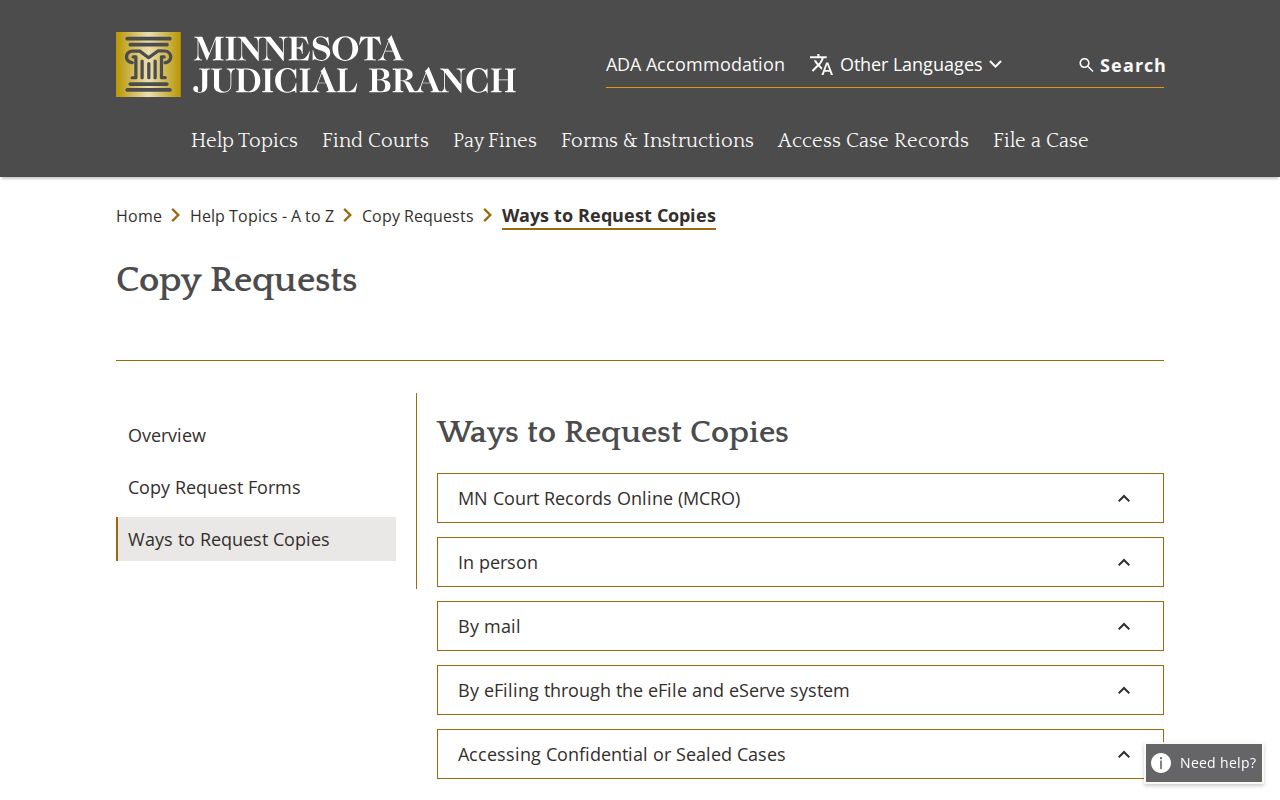
Every method taps the same Wabasha County court record system in the end. What shapes the response is the record you ask for and the copy type you need.
Court Record Types
Name the exact item when you request a court record. The Register of Actions is the docket itself. It is a chronological log of filings, orders, hearing settings, and outcomes. A plain copy is just an informational reproduction with no certification. A certified copy carries the court's official attestation for uses that demand one. An exemplified copy goes a step further. It adds signatures or certifications as required, and a transcript is produced separately through the court reporter route.
Other record types a request can target include a public pleading, order, judgment, document image, financial record, or transcript of judgment. Asking for "everything" invites confusion, extra cost, or an access-rule wall. Give Court Administration a confirmed case number plus a named document or event date. The lookup then moves fast. One limit is fixed. Staff can explain which copy types exist for a public file, but no request turns a restricted file into an open one.
Wabasha Certified and Plain Copies
Copies of Wabasha County court records do not all cost the same. MCRO public documents are free to view or download. Plain copies cost nothing either. The county's own fee page lists plain, uncertified copy, printout, scan, and screen copy at $0. Certification is where money enters. A certified copy of a civil or criminal instrument runs $14. A certified printout of an imaged or e-filed document pulled through courthouse MNCIS is also $14. Check the county-filtered fee list before you pay, since these are local charges set by Wabasha Court Administration.
Other services sit on the same fee page. An exemplified and certified copy costs $28. An exemplified and uncertified copy costs $14, and a certified judgment search runs $5 per name. One caution applies here. A generic statewide fee view has displayed a conflicting $28 amount for a certified imaged document. Do not mix the two figures. Pick Wabasha County and confirm the exact service with Court Administration before sending payment.
The Wabasha District Court fee search shows the official local fee schedule for these copy services.
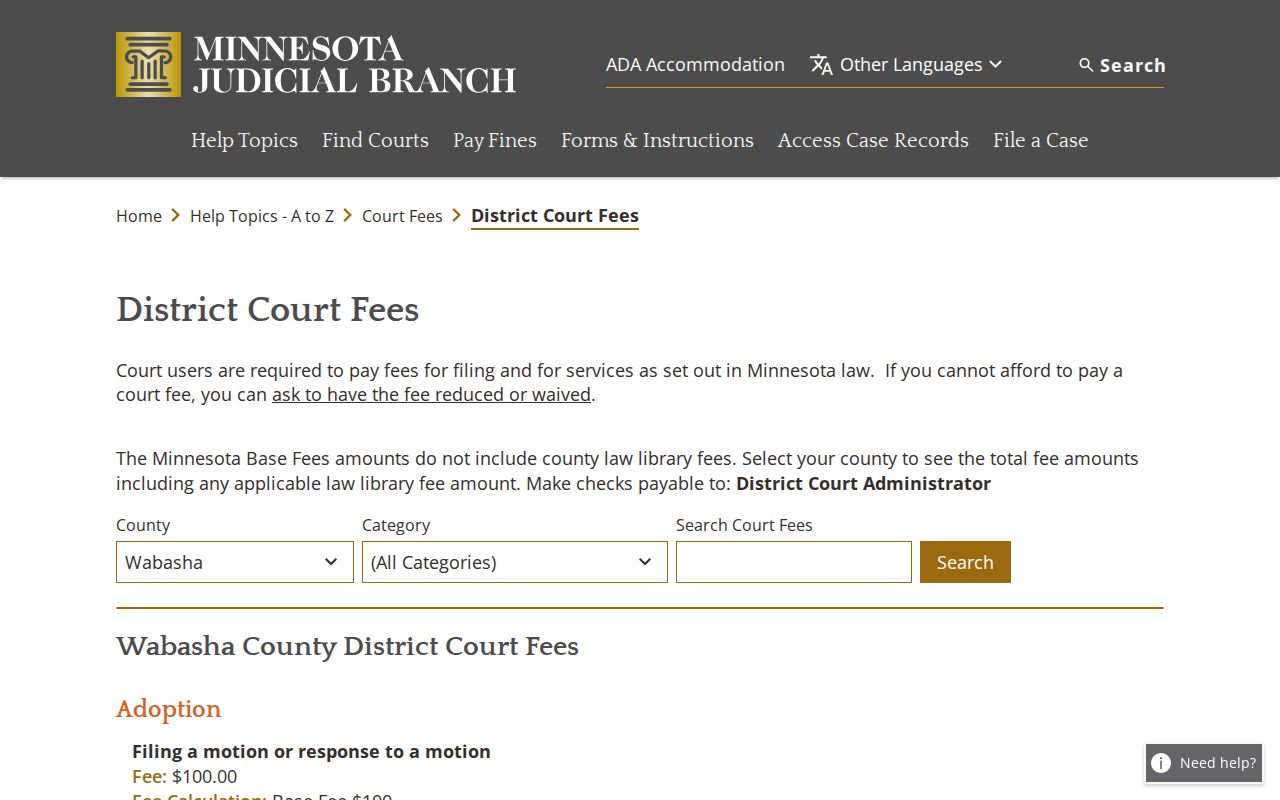
When a copy needs certification, the Wabasha-filtered fee result beats a generic statewide display for getting the right price.
Inside a Wabasha County Court Record
A Wabasha County court record can hold a lot of detail. Expect a case number, title, and case type. Filed date, court location, judicial officer, status, related cases, party role labels, and attorneys appear too. Most records also carry tabs for Case Events, Hearings, Dispositions, and Financial Information. A criminal docket goes further. It may display Charges, Warrants, Interim Conditions, Case Assignment, and Bond/Bail Activity. Civil records can show many event types. A complaint, service, answer, motion, order, hearing, judgment, dismissal, or satisfaction may all appear.
| Register of Actions | Chronological case events, filings, orders, settings, and available document indexes. |
|---|---|
| Public document | An image available in MCRO when the filing date, case type, and access rules permit it. |
| Certified copy | Court-certified reproduction issued through Court Administration, not by MCRO. |
| Judgment record | Docketed judgment and available satisfaction or financial information. |
| Transcript | Reporter-produced record of a proceeding, requested separately. |
One limit matters. Case Events are not the full legal text of a filing, so reading them is not the same as reading the document itself. A public online image may answer the need, but an official use can require a certified Wabasha court copy.
Wabasha Transcript Requests
A transcript sits outside the normal MCRO Document Search. Plan on a separate request. The statewide Transcript Request Form gathers the basics. It asks for your contact details, the case caption and number, the date of the proceeding, and the judicial officer. You also pick the segment you need. Choose a delivery method and ordinary or expedited service. Payment details or in-forma-pauperis information goes on the form too, along with a signature. For Wabasha questions, the court reporter line is (651) 412-8633.
The statewide rate policy sets the price per page. Civil, family, probate, mental-health, child-protection, SPP, and SDP matters run $5.75 per page. Criminal and juvenile transcripts cost $4.25 per page. An IFP transcript is also $4.25. Expedited service means a negotiated rate instead of a fixed one. Transcripts arrive electronically now; the policy describes no paper delivery. Before you count on availability, scope, or turnaround, call the reporter.
Note: a transcript request hinges on the particular proceeding and its date, while a Register of Actions request works from the Wabasha case record and its event history.
Fees and Certified Copies
What you pay depends on the service. The Wabasha page puts system reports at $5 for 1–50 pages. Beyond that, the charge is $25 per 50 pages or part. Scanning and fax carry the same $25 per 50 pages or part. A transcript of judgment runs $40. The court's fee page also covers filing fees, subpoenas, and expungement costs. Those are not ordinary record-copy charges at all.
| Wabasha record service | Listed amount | Local note |
|---|---|---|
| Plain copy, printout, scan, or screen | $0 | Informational, not certified. |
| Certified instrument or imaged printout | $14 | Use county-filtered fee result. |
| Exemplified and certified copy | $28 | Formal authenticated copy. |
| Certified judgment search | $5 per name | Check calculation display with the court. |
| Transcript of judgment | $40 | Separate court service. |
Can't cover the cost? The Judicial Branch says a fee waiver may be within reach. Income, public assistance, or a true inability to pay can qualify a person. A judge still reviews the required materials. No waiver is granted before that review.
Wabasha Fee Waiver Route
The fee-waiver information spells out who might qualify. Income within 125% of federal poverty guidelines is one route, and so is receipt of public assistance or a simple inability to pay. To seek relief, a person files the required legal documents, an affidavit, and supporting proof for judicial review. A waiver is never automatic. It also leaves the public-access rules for a court record exactly where they were.
Talk to Wabasha Court Administration before counting on a waiver for a copy, filing, or transcript request. Staff can steer a case into the right local process, though the judge is the one who rules on the waiver materials. Keep the two questions apart: what a fee costs, and whether a record is public, sealed, or available remotely.
The official fee-waiver source lays out the income and affidavit route in full.
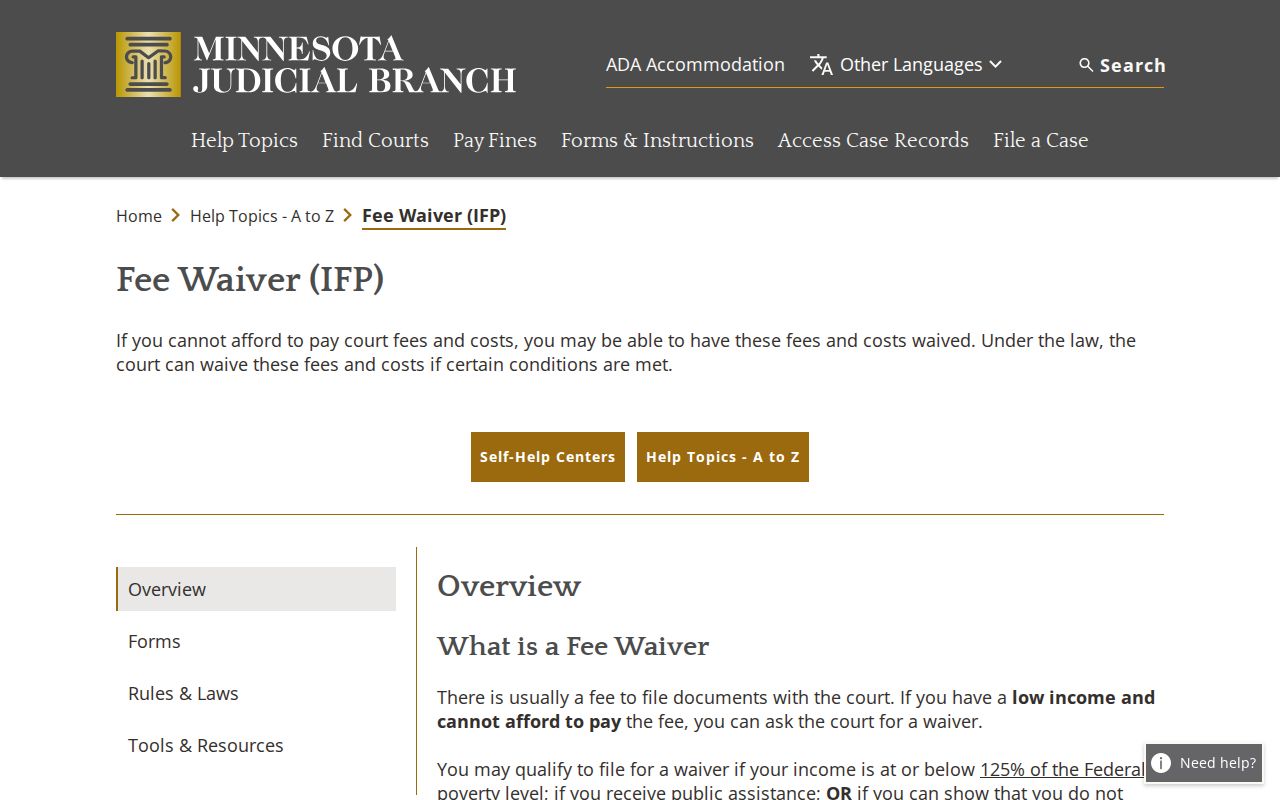
The Judicial Branch guidance helps keep a Wabasha fee question separate from a request to reach restricted court material.
Sealed Records and Public Access
Supreme Court rules, not a general statute, govern access to Minnesota court records. Minn. R. Pub. Access 8 covers inspection, copies, remote access, excluded data, confidential categories, and bulk access. Which categories are public and which are not? Minn. R. Pub. Access 4 answers that. Under Minn. Stat. § 13.90, the judiciary sits outside the ordinary Data Practices Act framework, so court rules control judicial records.
Public does not mean unrestricted: Remote MCRO access excludes sensitive identifiers and limits particular categories. A courthouse terminal can supply broader authorized access, but it cannot bypass a sealed record or a court order.
Facing a restricted Wabasha file? Ask Court Administration what public index, order, inspection path, or motion process exists. Don't bank on a routine data-practices deadline. And never ask a city clerk to certify a Wabasha District Court judgment.
Wabasha Terminal Records
Think of the options as separate doors. MCRO is the remote layer for docket search and public documents. The courthouse public-access terminal, meanwhile, can show more complete authorized electronic material. The Court Administration counter and main phone serve as the in-person route. That route covers certified copies and local paper-file access. A mail request fits a specific ask when a trip to the courthouse isn't practical.
Wabasha County District Court Administration
848 17th Street East, Suite 4
Wabasha, MN 55981
(651) 412-8627
Monday through Friday, 8:00 a.m. to 4:30 p.m.
Appellate and federal cases live elsewhere. An appellate record sits in P-MACS, and a federal record sits in PACER. The Wabasha terminal and counter handle District Court material only. They do not cover an administrative city ticket that never entered the state court system. So know your court, your record type, and your case number. Then pick a channel.